
The SELF online placement test is reaching a new milestone with the development of a speaking assessment module, the component that was missing until now to cover the four fundamental skills. This module will complement the current assessments of listening, reading, and short writing, thus offering a more complete picture of learners' language abilities.
The SELF Production Orale project (SELF PO) is the result of a collaboration between the Laboratoire de Linguistique et Didactique des Langues Étrangères et Maternelles (LIDILEM) and the Laboratoire d'Informatique de Grenoble (LIG).
Two modules are currently under development: one for English, the other for French, the latter developed in collaboration with the University Center for French Studies (CUEF) and the Association of Directors of University Centers for French Studies for Foreigners (ADCUEFE).
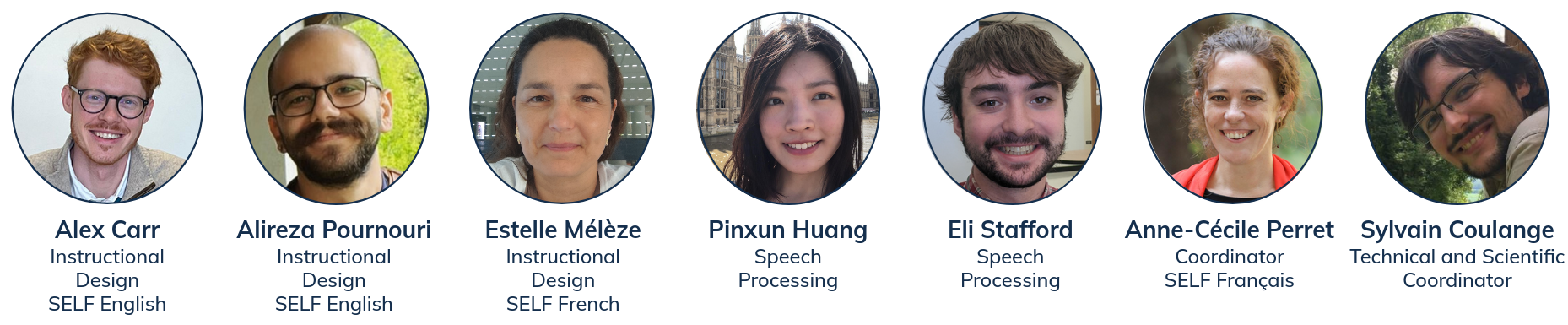
Scientific Team
Progressive funding for a major project
The project benefits from substantial financial support from Université Grenoble Alpes:
- Early 2025: €18,000 (IRGA funding - Research Initiatives at Grenoble Alpes) to initiate the work
- May 2025 - November 2026: €130,000 (FITInnovE - pre-maturation innovation) to develop and integrate the English module
A cutting-edge technological approach
Automatic speaking assessment employs advanced speech processing technologies: speech recognition, syntactic and semantic analyses, extraction of speech representations from self-supervised models, and score prediction based on multiple linguistic parameters. These tools enable systematic, standardized, and large-scale assessment.
How does it work?
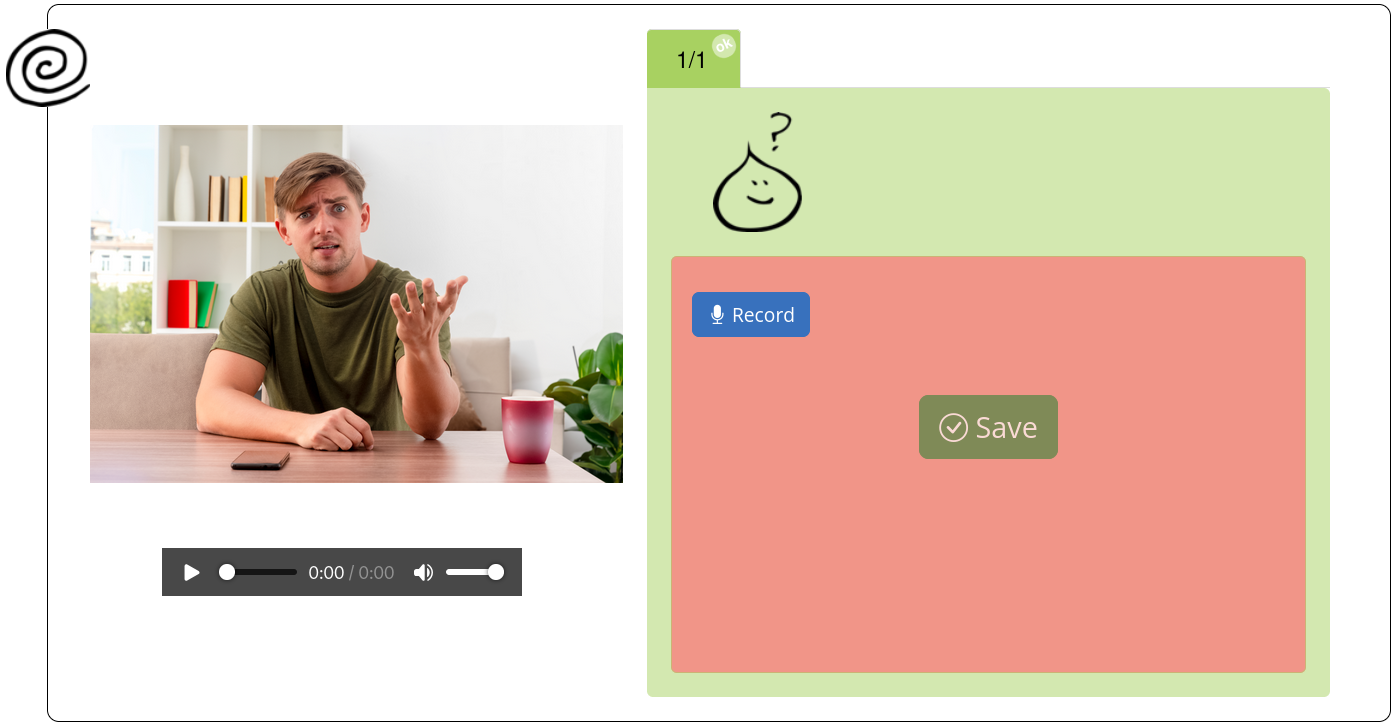
At the end of the test, students will respond orally to a series of questions by recording themselves via their microphone. An oral production score will be automatically calculated from these recordings and will enrich the SELF skills profile.
On the technical side, the SELF PO project consists of training a statistical model to predict a proficiency score based on various measurements taken from a student's oral production. This training is carried out using reference scores established by a panel of expert raters on a corpus of a large number of recordings spanning all proficiency levels. The model then learns to recognize patterns in these measurements: for example, productions from higher-level learners tend to be more fluent, lexically richer and more precise, syntactically more complex with fewer errors. As a result, a new production exhibiting these characteristics will be assigned a higher level.
What does SELF measure?
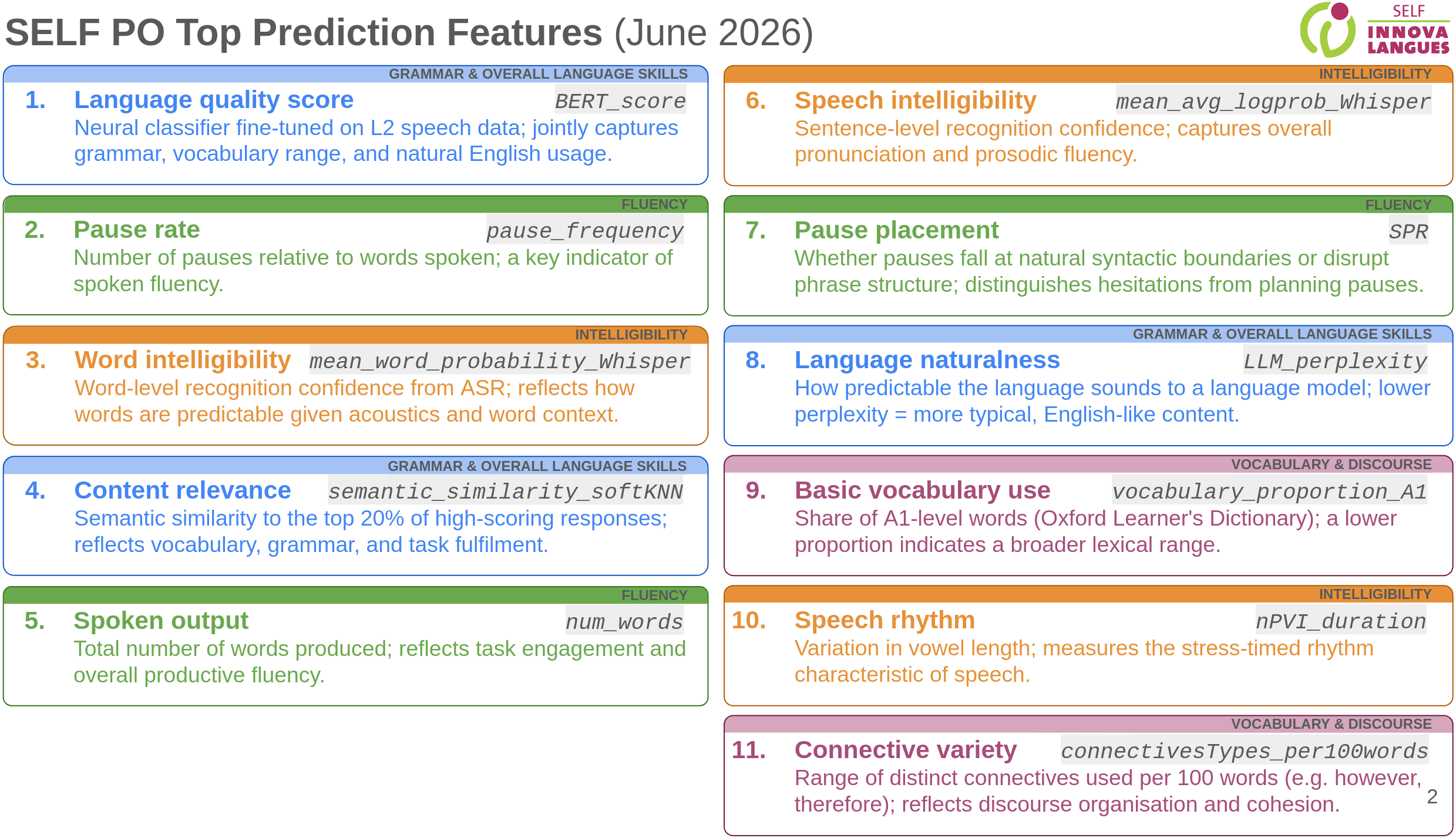
The current version of the scoring model takes 52 prediction features as input to compute students' speaking score. These features are automated measures of speech covering speaking skills as broadly as we can: surface (e.g. pronunciation, fluency), linguistic (e.g. vocabulary, grammar) and discurse (e.g. semantics, topic). The figure below shows the top features the model relies on:
How do we evaluate the scoring accuracy?
The accuracy of the scores produced by the model is evaluated against the reference scores established by the panel of expert raters. The goal is to ensure that the automatic scores align as closely as possible with those given by humans. We have implemented a cross-validation protocol that trains the model on 90% of the data and tests it on the remaining 10%, then repeats this process 10 times so as to cover the entire corpus without ever testing the model on a recording it has seen during training (which would bias the score). In the case of the model trained for English, we obtained a mean absolute error rate of 0.521 (equivalent to half a CEFR level; RMSE = 0.637; weighted F1 = 0.535) when evaluating recordings individually, and a correlation of 0.848 (p < 0.001) between the student's level as determined by the machine and that given by the human raters (average of the scores obtained by a given student across the different test questions).
Expected availability: end of 2026
To learn more, watch the presentation of the SELF PO project during the webinar organized by the University of Lille in September 2025:
Link to the Video (in French): https://www.youtube.com/watch?v=l8TcJO4hizU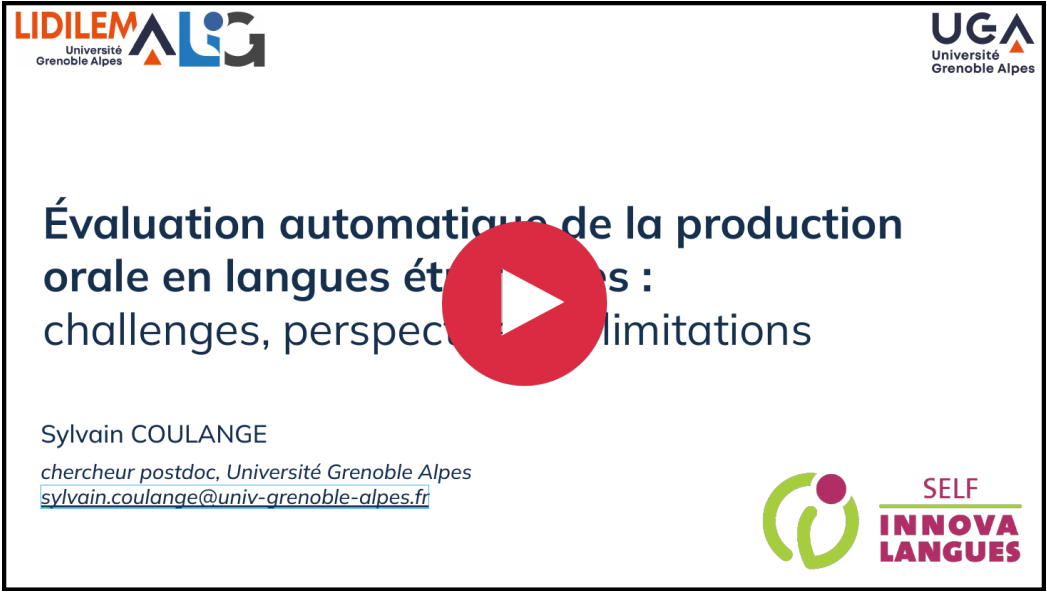
Presentation at the UGA Language Center (June 11, 2026):
Link to the video (in French): https://videos.univ-grenoble-alpes.fr/video/37722-presentation-du-projet-self-production-orale-12-juin-2026/